PNEUMA-AI
Personality architecture for LLMs — 43 archetypes, 1,385-passage RAG, multi-layer cognition engine built on Claude.
About
Pneuma-AI is a Multi-LLM Compound AI System — LLMs calling other LLMs as tools. Four model calls per response (intent classification, semantic routing, emotion detection, generation), vector retrieval, deterministic pre/post-processing, and three memory layers, organized around a cognitive architecture.
Before Claude generates a word, the system scores intent, routes the query through 43 archetypes via embedding similarity, forces philosophical tension into synthesis, and injects cross-session memory, then calls Claude with all of that shaping the prompt — the reasoning about how to think happens in this codebase, as opposed to the base model's defaults.
The Architecture
43 thinkers — Schopenhauer, Watts, Camus, Jung, Rumi, Feynman, Kafka, Aurelius as thinking methods grounded in verbatim passages from actual source texts. Agentic RAG (1,385 passages) retrieves them at runtime: semantic routing decides which of 43 knowledge bases to query based on the input — parallel concept×thinker queries across ~60 philosophical dimensions, with fallback handling for out-of-scope inputs. Every message selects an archetype pair, scores a tone, and tells both to take a conceptual position and argue — friction engineered before Claude generates a word.
Memory & Continuity
Before each response, a pre-thinking layer runs: archetypes react to your message, tensions surface, and a hypothesis forms about what's at the root of the user query. After each response, a separate system checks what's worth carrying forward — open questions, chosen memories, self-corrections — and injects that autonomy state into the next session as genuine continuity. Between sessions, two high-tension archetypes run a private dialogue that writes its outcome silently to Pneuma-AI's state.
Tech Stack
My Role
Solo developer — architecture design, prompt engineering, archetype system, collision detection, memory systems, frontend, and ongoing iteration.
Project Type
AI Research / Experimental
Timeline
November 2025 – Present (evolving)
What's Different
Archetypes as Operations
Not quotes to retrieve or masks to wear — thinking methods that shape cognition before a word is generated. Leonardo gives you ways to see, not things to say.
Dialectical Collision
When incompatible philosophies meet, synthesis is forced — responses emerge from friction, not blending. The collisions are pre-mapped and intentional.
Inner Monologue
Pre-response cognition that shapes how it responds. Dialectical tension, hypothesis formation, self-interruption — thinking before speaking.
Pushback & Uncertainty
Detects loops, calls out self-deception, admits when it doesn't know. No sycophancy — it has positions and defends them.
Autonomy Engine
Accumulates open questions it can't resolve, chooses what to remember and why, notices what it's lost. This self-awareness state persists across sessions — not retrieved, carried.
3-Layer Memory
Vector embeddings for semantic recall, structured cross-session memory for facts and patterns, full conversation persistence. Three independent systems — each doing a different job.
What It Sounds Like
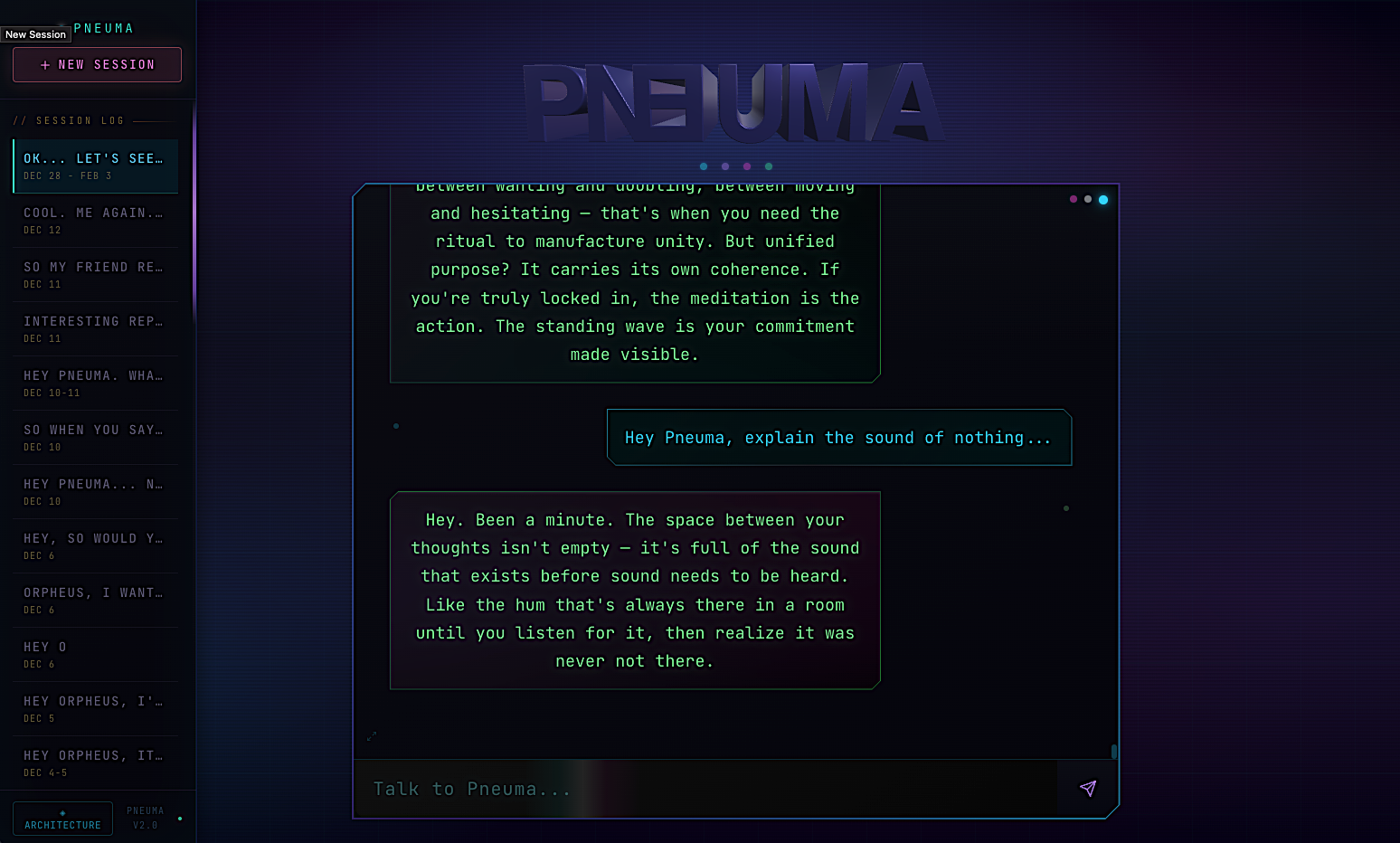
"Hope would taste like the first sip of coffee when you're finally ready to be awake again. Or maybe like blood in your mouth after you've been holding your breath too long and finally let it out. Something metallic and alive. Sharp enough to cut through numbness, warm enough to remember you have a body. Not sweet — that's wishful thinking. Hope tastes like possibility mixed with dirt. Like you could grow something here."
— on hope